
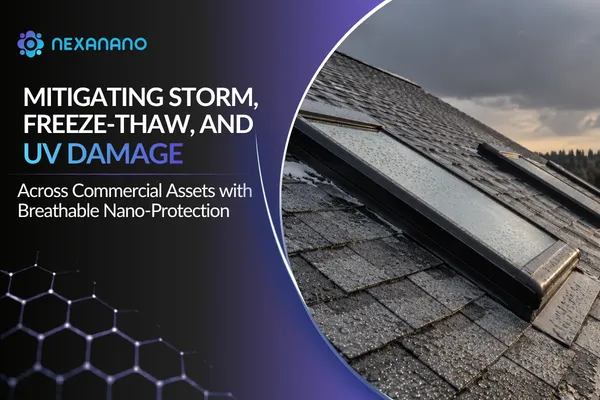
Mitigating Storm, Freeze-Thaw, and UV Damage Across Commercial Assets with Breathable Nano-Protection
Commercial real estate assets are locked in a continuous battle against environmental deterioration. Whether managing multi-family developments, industrial distribution centers, retail strips, or corporate office campuses, property managers and facility directors oversee building envelopes exposed to relentless weather cycles.
From extreme summer heat and harsh ultraviolet (UV) radiation to driving rain and heavy freeze-thaw cycles, exterior building materials endure relentless stress. Left unaddressed, environmental wear causes moisture infiltration, structural cracking, surface spalling, and granule loss. This forces property management teams into a constant cycle of expensive, reactive repairs and premature capital expenditure (CapEx) replacements.
Protecting concrete walkways, commercial roofs, and hardscapes requires moving beyond traditional topical coatings. Advanced, breathable silicon dioxide ($SiO_2$) nanotechnology offers commercial asset owners a proactive strategy to fortify structural integrity, lower maintenance costs, and extend overall surface lifespans by up to 10 years.
The Hidden Mechanics of Commercial Substrate Failure
To understand why traditional exterior surfaces degrade rapidly, facility managers must look beneath the surface. Building materials like concrete, clay, stone, and asphalt shingles are naturally porous. While this porosity allows for structural flexibility, it also leaves the surface vulnerable to environmental degradation.
1. Freeze-Thaw Hydraulic Pressure
When water penetrates porous concrete or masonry, cold weather causes that trapped water to freeze and expand by roughly 9% in volume. This volumetric expansion creates intense internal hydraulic pressure within the material’s pore network. Over repeated cycles throughout the winter, this internal pressure causes micro-fractures, eventually escalating into surface scaling, spalling, and deep structural cracking.
2. UV Degradation & Granule Erosion
Solar ultraviolet radiation breaks down chemical bonds in asphalt roofing materials, causing shingles and membrane surfaces to lose essential oils, dry out, and become brittle. As shingles lose flexibility, protective surface granules loosen and wash away. This exposes underlying layers directly to moisture and wind, leading to leaks and structural failure.
3. Moisture Ingress & Biological Growth
Unprotected, damp surfaces create ideal breeding grounds for algae, moss, and cyanobacteria. Beyond generating unsightly stains on commercial facades and walkways, biological growth roots into micro-fissures, trapping moisture against the surface and accelerating material decay.
The Flaw in Traditional Topical Sealants
For decades, standard commercial maintenance relied on topical film-forming coatings—such as acrylics, polyurethanes, or heavy petroleum-based sealers. While these products temporarily block external water, they introduce significant long-term drawbacks for commercial facilities:
Trapping Internal Moisture: Traditional coatings create an impermeable film over the surface. Ground moisture vapor rising through concrete slabs or humidity escaping from inside a building gets trapped underneath the coating, leading to blistering, delamination, and hidden internal decay.
Peeling and Flaking: Because topical sealants only sit on top of the material rather than penetrating it, constant foot traffic, vehicle loads, and UV exposure rapidly wear them down. They peel, flake, and require complete removal and reapplication every 2 to 3 years.
High Maintenance Costs: Frequent re-application demands continuous labor overhead, surface prep, and disruption to commercial operations or tenant parking access.
The NexaNano SiO₂ Innovation: Breathable Nanotechnology
NexaNano takes a fundamentally different approach to surface protection. Rather than forming a heavy layer on top of a substrate, NexaNano utilizes engineered silicon dioxide ($SiO_2$) nanoparticles thousands of times smaller than the pores of building materials.
When applied by certified commercial installers, these micro-particles penetrate deep into the substrate, bonding directly with the interior pores at the molecular level.
Key Technical Advantages of NexaNano Commercial Formulations
True Subsurface Hydrophobicity: The formula lines the internal pore walls with a hydrophobic layer that repels liquid water and water-borne contaminants like salt, oil, and chemicals.
Complete Vapor Permeability (Breathability): Liquid water molecules are too large to penetrate the treated pore network, but moisture vapor molecules are small enough to escape freely. This allows the building envelope to breathe naturally, eliminating internal pressure buildup.
No Aesthetic Alteration: Unlike thick paints or glossy sealers that discolor over time, NexaNano leaves no film, keeping natural stone, concrete, and roofing materials visually unchanged.
Zero-VOC, Eco-Safe Composition: NexaNano formulas contain zero volatile organic compounds (VOCs), zero petroleum oils, and zero toxic solvents. Applications are safe for surrounding landscaping, property runoff systems, and indoor air quality.
Real-World Asset Protection & Field Performance
This advanced molecular science delivers clear operational benefits across commercial property portfolios.
Commercial surface protection results are validated directly by trade professionals working on properties across North America:
"I have done concrete coatings for 10 plus years and have never seen a product like the Nexa Nano Concrete Waterproofing product. It completely sheds water without changing the look of the concrete. It's nothing like conventional acrylic or polyurethane sealers that require resealing/recoating in a few years..."
— Troy Ronspies, Professional Concrete Installer
Property managers also see long-term protection on high-traffic hardscapes and concrete assets:
"It's been over a year, and the surface still repels water and stains like it did on day one... Knowing it's protected for 8–10 years gives me such peace of mind."
— Jace Kelly, Property Owner
Strategic Applications Across Commercial Portfolios
Integrating NexaNano into preventive maintenance plans delivers measurable cost savings across diverse commercial asset classes:
Multi-Family & Residential Communities: Protects common walkways, stairwells, swimming pool decks, and asphalt roofing shingles. Extending shingle performance up to 15 years keeps tenant disruptions low while delaying massive re-roofing expenditures.
Industrial Facilities & Warehouses: Seals loading docks, concrete staging pads, and parking aprons against freeze-thaw damage, heavy vehicle abrasion, chemical spills, and oil stains.
Retail Centers & Hospitality Properties: Maintains clean, attractive pedestrian walkways and outdoor seating areas by repelling food stains, beverage spills, and organic discoloration without requiring frequent high-pressure washing.
Protect Your Asset Value Before Storm Season Hits
Reactive property maintenance puts capital budgets at risk. Waiting until moisture intrusion causes spalling concrete or roof leaks leads to costly emergency repairs, tenant complaints, and premature material tear-offs.
By deploying NexaNano’s breathable, eco-safe nanotechnology, property teams can fortify existing building envelopes against weather cycles, lower ongoing maintenance overhead, and protect long-term portfolio value.

Ready to extend your property's surface lifespans by up to 10 years? Contact an authorized NexaNano surface protection expert today to schedule a comprehensive commercial property assessment.