
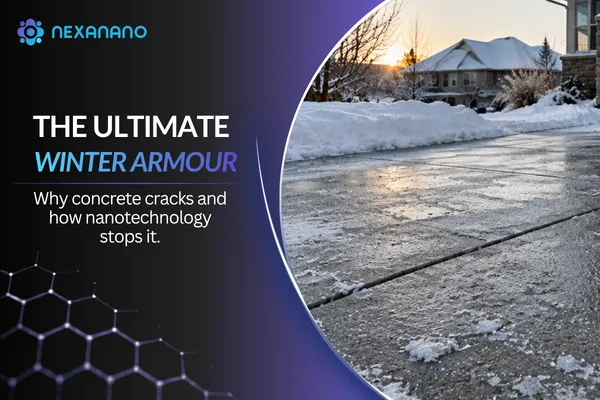
The Ultimate Winter Armor: Why Concrete Cracks and How Nanotechnology Stops It
When you look at a freshly poured driveway, walkway, or commercial slab, it looks impervious. Concrete is the foundational element of modern building and infrastructure. Yet, beneath its hard, solid exterior lies a structural vulnerability: concrete is a naturally porous, microscopic sponge.
Every winter, residential and commercial property owners face an expensive, recurring cycle of surface deterioration—spalling, pitting, scaling, and cracking. The primary culprits are freeze-thaw cycles and aggressive de-icing chemicals.
Historically, the standard defense was applying topical acrylic or polyurethane sealers. However, these surface-level coatings often fail within a couple of seasons, peeling off and leaving the substrate exposed. Today, civil engineering and property maintenance are shifting toward advanced nanotechnology that seals concrete from the inside out.
Understanding why concrete fails during winter and how deep-penetrating nano-sealants work reveals why molecular protection is becoming the standard for modern property preservation.
The Science of Winter Damage: Why Unsealed Concrete Fails
To understand why winter weather breaks concrete down, you have to look at its microscopic composition. During the curing process, excess mixing water evaporates out of the concrete, leaving behind a network of microscopic capillaries and pores.
While invisible to the human eye, these micro-pores easily absorb moisture, water-borne salts, and chemicals.
1. The Freeze-Thaw Dynamic
When liquid water penetrates concrete capillaries and temperatures drop below freezing, that trapped water converts into ice. As water freezes, its volume expands by approximately 9%.
Confined within a rigid capillary wall, expanding ice generates internal hydraulic pressure. Over dozens of freeze-thaw cycles in a single winter season, this repeated internal expansion forces micro-fractures to spread. Over time, this leads to structural surface defects:
Spalling & Scaling: The top layer of the slab breaks away in thin flakes or chips.
Pitting: Microscopic pop-outs create a rough, pockmarked surface across the slab.
Deep Cracking: Surface micro-fractures merge, allowing moisture to reach internal steel reinforcement and compromise structural integrity.
2. De-Icing Chemical Degradation
To clear snow and ice, property owners frequently rely on sodium chloride, calcium chloride, and other de-icing agents. While effective for safety, these salts significantly accelerate concrete decay:
Accelerated Freeze-Thaw Frequency: De-icers artificially lower the freezing point of water, increasing the total number of freeze-thaw cycles per week.
Chemical Breakdown: Chloride ions react with the calcium compounds inside cement paste, breaking down the binder and corroding internal rebar.
Why Topical Coatings and Traditional Sealers Fail
For decades, the standard approach to surface protection was applying an acrylic, silicone, or polyurethane surface sealer. While these products create a temporary barrier, they suffer from a fundamental design flaw: they form a topical surface film.
Topical sealers sit on top of the concrete rather than penetrating into its molecular matrix. This creates several long-term problems:
Trapped Moisture Pressure: Topical films block concrete breathability. Moisture rising from the ground below becomes trapped under the film. When that trapped water freezes or converts to vapor under direct sunlight, it forces the coating to bubble, blister, and peel.
UV Degradation: Solar ultraviolet radiation breaks down organic polymers in acrylic coatings, causing them to turn yellow or cloudy within 12 to 24 months.
Mechanical Abrasion: Tire friction, foot traffic, snow shovels, and plow blades quickly scrape away surface films, exposing the underlying concrete once again.
The NexaNano Solution: Molecular-Level Hydrophobic Defense
Nanotechnology approaches surface protection from a completely different angle. Rather than placing a plastic layer over the surface, NexaNano treatments utilize nano-sized particles—thousands of times smaller than a human hair—suspended in an eco-safe carrier liquid.
When applied to clean concrete, these microscopic particles penetrate deep into the open capillary network rather than remaining on top.
How Nanotechnology Works Within Concrete:
Deep Pore Penetration: Nano-molecules travel deep into the micro-porous structure of the concrete matrix.
Permanent Molecular Bonding: The formulation reacts chemically with the free minerals inside the concrete capillaries, creating an integrated, invisible chemical bond.
Hydrophobic Surface Modification: This reaction permanently changes the inner walls of the pores from water-attracting (hydrophilic) to water-repelling (hydrophobic).
Because this reaction occurs internally within the pore structure, the treatment leaves no surface film, no gloss, and no slipperiness. The concrete retains its natural appearance and full breathability, allowing internal moisture vapor to escape safely while blocking liquid water, chloride ions, and environmental contaminants from entering.
The Professional 2-Step Application Process
Achieving a long-lasting protective barrier requires precision execution. Professional application of NexaNano penetrating sealants follows a structured two-step process:
Step 1: Surface Cleaning & Pore Restoration
Before nano-molecules can bond, the substrate must be entirely free of surface contaminants.
Pressure Washing: Technicians use pressure washing or soft-washing equipment to strip away dirt, grime, oil stains, mold, and failing coatings.
Capillary Unclogging: Removing embedded debris opens the microscopic pore network, ensuring the nano-treatment can penetrate deeply into the slab without obstruction.
Step 2: Precision Deep-Pore Saturation
Once the surface is prepared and thoroughly dried, the deep-penetrating treatment is applied.
Uniform Spray Application: Using specialized spraying techniques, the liquid formulation is applied evenly across the entire surface.
Substrate Saturation: The application rate is tuned to ensure the concrete absorbs the exact volume necessary for deep saturation. The liquid draws inward, forming an internal hydrophobic bond that will not peel, flake, or wear away under heavy traffic.
Verifiable Benefits for Property Owners and Facilities Managers
Switching from temporary topical coatings to deep-penetrating nanotechnology delivers clear operational and economic advantages:
100% Breathable Protection: Allows internal moisture vapor to pass through without causing surface blistering or delamination.
Chloride & Salt Resistance: Blocks de-icing chemicals and salt ions from penetrating into the matrix, preventing binder breakdown.
Freeze-Thaw Resistance: Eliminates liquid water ingress, preventing internal hydraulic pressure from causing surface spalling or cracking.
Preserved Natural Aesthetics: Leaves zero oily residue, gloss, or discoloration, preserving the original appearance and slip-resistance of the concrete.
Eco-Safe & U.S. Made: Formulated without harsh oils or toxic chemicals, making it safe for surrounding lawns, landscaping, and runoff systems.
Long-Term Protection: Delivers multi-year performance (lasting up to 10 years depending on surface conditions and application) without requiring frequent stripping or recoating.
Proactive Preservation vs. Demolition Costs
Replacing a damaged residential concrete driveway or commercial walkway can easily cost thousands in demolition, labor, permits, and materials. Beyond the financial burden, replacement creates significant downtime and disruption.
Investing in deep-penetrating molecular protection extends the functional lifespan of existing concrete structures. By preventing freeze-thaw spalling and salt damage before it starts, property owners protect their capital investments and reduce ongoing maintenance overhead.
Is your property prepared for winter freeze-thaw cycles? Discover how NexaNano provides advanced, deep-pore protection engineered to shield concrete, masonry, wood, and roofing assets. Visit nexanano.com to learn more about our eco-safe surface protection solutions and professional installer network.